Moroccan Rug Weaving: Berber Rugs, Symbols and the Women Who Weave Them
In short: Moroccan rugs are woven mostly by Amazigh (Berber) women on vertical wooden looms, using wool from their own region. Each area has its own style: thick cream Beni Ourain rugs from the Middle Atlas, colourful Azilal rugs from the High Atlas, flat-woven kilims (hanbel), rich Taznakht rugs from near Ouarzazate and recycled boucherouite rag rugs. A rug can take from several weeks to several months to weave.
A Moroccan rug is far more than a floor covering. In the Atlas Mountains, rugs were woven to sleep on, sit on, keep out the cold and mark the big moments of family life. Their patterns, passed down from mother to daughter, carry wishes for protection, fertility and good fortune.
This guide explains how Moroccan rugs are woven, the main regional styles and what their symbols are said to mean, and where you can sit at a loom and weave yourself on a trip to Morocco.
Amazigh Weaving: A Women’s Art
In rural Morocco, weaving has always been women’s work. Girls learned at their mother’s side, first spinning wool, then helping at the loom, then weaving their own rugs. Most rugs were made for the family’s own use, not for sale: for sleeping, sitting, covering the floor of a tent or house, or as part of a bride’s belongings.
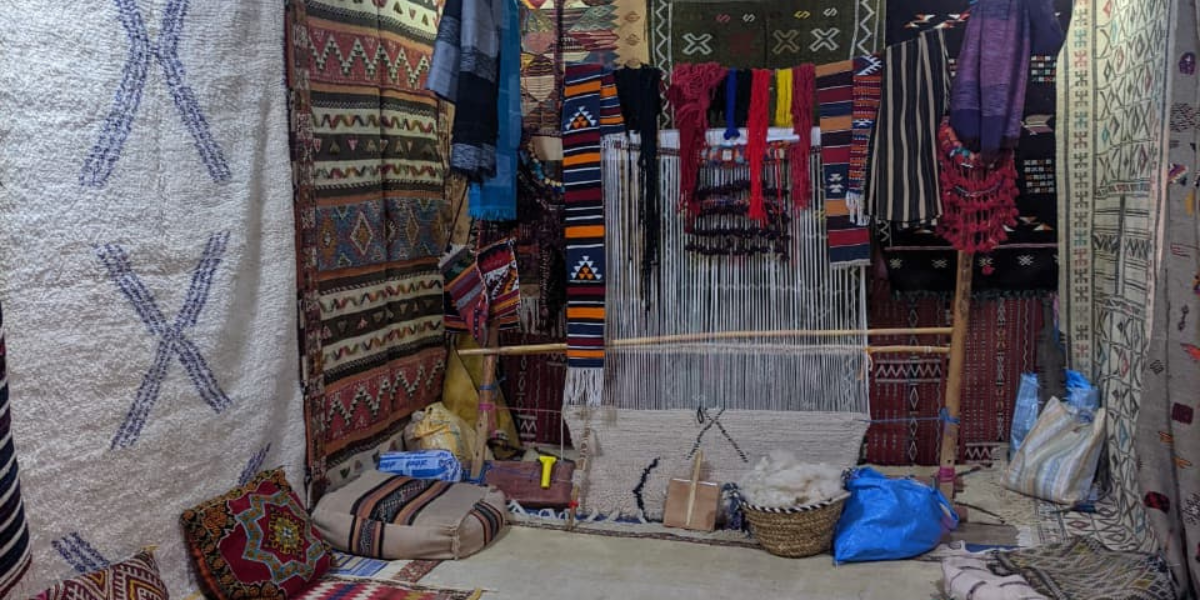
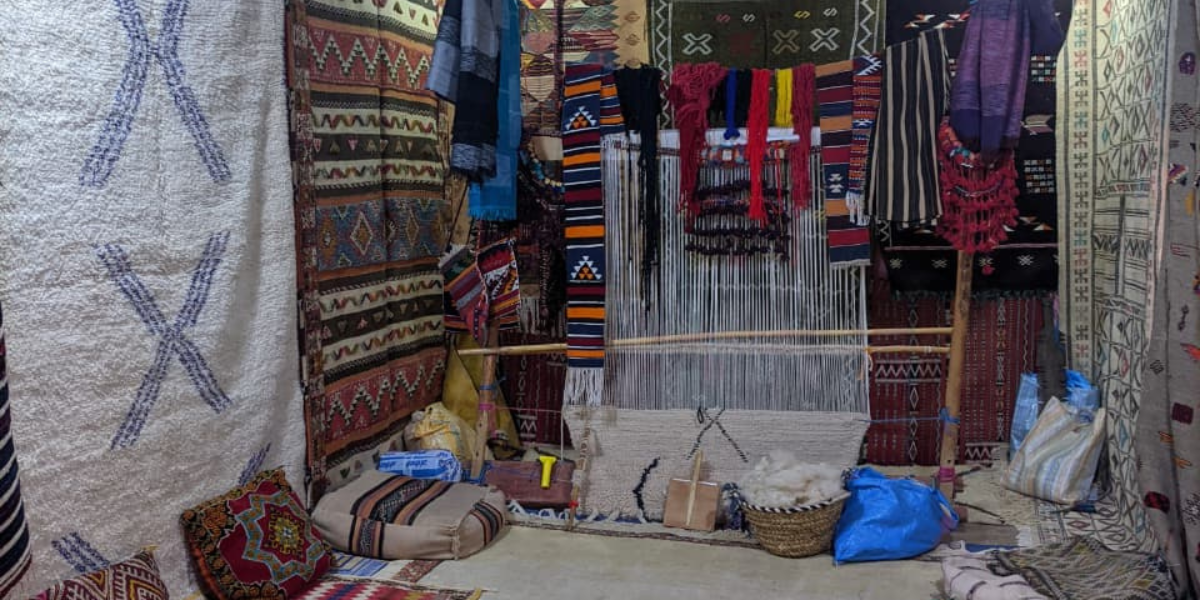
Rugs are woven on a simple vertical loom: two wooden beams, upright posts and the warp threads stretched between them. The loom is often set up against a wall in the home, and a large rug may stay on it for months.
Two main techniques
- Pile (knotted) rugs: the weaver ties short pieces of wool around the warp threads, row by row, to create a soft, raised pile. Beni Ourain and Azilal rugs are made this way.
- Flat-woven rugs (hanbel or kilim): no knots and no pile. The coloured weft threads are woven tightly through the warp, making a thin, light and often reversible rug that is easy to carry.
The Main Styles of Moroccan Rugs
| Style | Region | How to recognise it |
|---|---|---|
| Beni Ourain | Middle Atlas | Thick, soft pile in natural cream or ivory wool, with a simple lattice of dark brown or black diamond lines |
| Beni M’Guild / Beni Mrirt | Middle Atlas | Thick wool pile, often in deep red and blue with geometric patterns |
| Azilal | High Atlas | Cream or beige background with bold, colourful, freehand symbols, often woven without a fixed plan |
| Boujad | Plains east of Casablanca | Warm pinks, reds and purples in loose, abstract designs |
| Taznakht | Anti-Atlas, near Ouarzazate | Dense, richly coloured rugs, traditionally dyed with natural colours such as saffron, henna, madder and indigo; often mix pile and flat weave |
| Hanbel / kilim | Across Morocco | Flat-woven, light and reversible, with bands and geometric patterns |
| Boucherouite | Across Morocco | “Rag rugs” woven from strips of recycled fabric, in joyful, unexpected colours |
Good to know: a style name such as “Beni Ourain” or “Azilal” describes a tradition, not a guarantee. Many rugs sold under these names are made elsewhere, in the same style. If origin matters to you, buy from a cooperative that can tell you where and by whom the rug was woven.
Symbols in Moroccan Rugs and What They Mean
Many Amazigh rugs are covered in symbols, some of them shared with traditional women’s tattoos and the Amazigh Tifinagh script. Their meaning is not fixed like a dictionary: it varies from tribe to tribe, and each weaver adds her own story. Still, some motifs are commonly associated with the same ideas:
| Motif | Common meaning |
|---|---|
| Diamond (lozenge) | The most common motif: femininity, fertility and protection. A diamond inside a diamond can mean protection layered on protection. |
| Eye shapes | Protection against the evil eye |
| Crosses and X shapes | Protection and warding off bad luck |
| Zigzag and wavy lines | Water, movement and the journey of life |
| Grains and small dots | Abundance and fertility |
| Branches and tree shapes | Family, growth and roots |
Colours carry meaning too, and in the past they also showed which plants and minerals were available locally for dyeing.
How a Moroccan Rug Is Made: From Sheep to Rug
- Shearing and washing. Sheep’s wool is sheared, then washed to remove dirt and natural grease.
- Carding. The clean wool is combed with carding brushes to untangle the fibres.
- Spinning. The fibres are twisted into yarn by hand, traditionally on a wooden drop spindle.
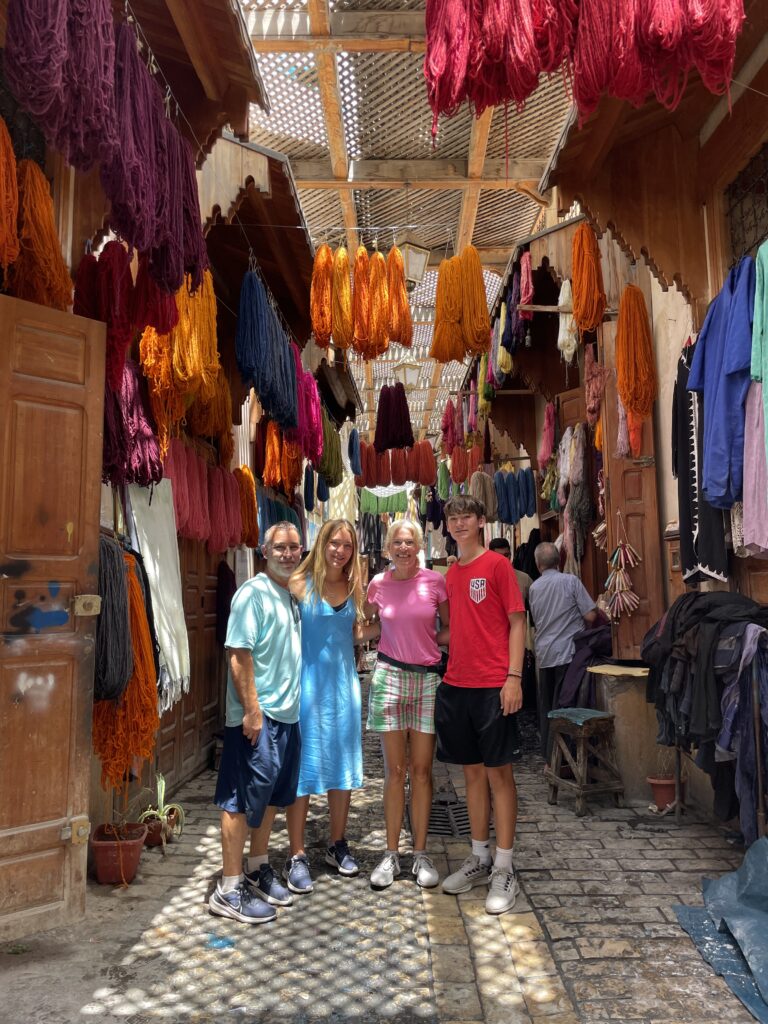
- Dyeing. The yarn is dyed, traditionally with plants and minerals such as henna, madder, saffron and indigo, today often with modern dyes.
- Setting up the loom. Warp threads are stretched tightly between the top and bottom beams of the vertical loom.
- Weaving. Row by row, the weaver ties knots (for a pile rug) or passes the weft threads (for a flat-weave), then beats each row down tightly with a heavy metal comb.
- Finishing. The rug is cut from the loom, the pile is trimmed evenly and the ends are knotted into fringes.
Depending on its size and design, a rug can take from several weeks to several months to finish, often woven by one woman or a few women working side by side.
Where to Learn Rug Weaving in Morocco
Fes: the Anou Cooperative
Anou is a cooperative owned and run by Moroccan artisans. At their store in the Fes medina, an Anou artisan leader teaches you to weave on a mini loom in a half-day workshop: you sketch your own design and choose your colours from local wool. Anou also offers natural dyeing and hand-spinning workshops, and a one-week weaving residency where you weave a medium-size rug on a full vertical loom.
Marrakech: Art House Marrakech
At Art House Marrakech, skilled artisans, many of them from the Atlas Mountains, teach rug weaving in a 2.5 to 4-hour session, and you take home a small woven rug.
The Anou weaving workshop is Day 5 of our 12-day Morocco arts and crafts tour, and we can add either workshop to any private itinerary. See all our Morocco artisan tours, or explore Amazigh life on our Berber cultural tours.
How to Buy a Moroccan Rug Without Pressure
- Turn it over. On a hand-knotted rug you can see each knot on the back, with small irregularities. Machine-made rugs have a perfectly even back.
- Ask where and by whom it was made. Cooperatives can usually tell you the village and even the weaver.
- Take your time. Never feel rushed by tea, compliments or “last price” pressure. It is fine to leave and think about it.
- Check shipping in writing. If the seller ships the rug home, ask for the price, delivery time and a receipt.
- Buy what you love. A rug you will live with for years is worth more than a “bargain”.
On our tours there are no shopping stops. You meet weavers to learn from them. If you fall in love with a rug, you are free to buy it directly from the makers, without any pressure.
Want to discover Morocco’s other crafts? Read our guide to Moroccan crafts and our articles on embroidery and zellige.
Moroccan Rug Weaving: Frequently Asked Questions
Who weaves Moroccan rugs?
Moroccan rugs are traditionally woven by Amazigh (Berber) women, mostly in the Atlas Mountains and rural Morocco. The skill is passed from mother to daughter, and today many weavers work in cooperatives.
What is the difference between Beni Ourain and Azilal rugs?
Beni Ourain rugs come from the Middle Atlas and have a thick cream pile with simple dark diamond lines. Azilal rugs come from the High Atlas and have a cream or beige background covered with bold, colourful, freehand symbols.
What do the symbols on Moroccan rugs mean?
The most common symbol, the diamond, is associated with femininity, fertility and protection. Eye shapes and crosses protect against the evil eye, and zigzag lines often represent water or the journey of life. Meanings vary from tribe to tribe and from weaver to weaver.
How long does it take to weave a Moroccan rug?
A Moroccan rug can take from several weeks to several months to weave, depending on its size, the density of the knots and the complexity of the design.
What is a boucherouite rug?
A boucherouite is a Moroccan rag rug woven from strips of recycled fabric instead of wool, usually in bright, playful colours.
Can I learn to weave a rug in Morocco?
Yes. In Fes, the Anou Cooperative offers half-day weaving workshops and a one-week weaving residency, and Art House Marrakech offers rug-weaving sessions of 2.5 to 4 hours. Chegaga Travel includes the Anou weaving workshop in its 12-day Morocco arts and crafts tour.
Weave Your Own Rug in Fes
Join a private journey through Chefchaouen, Fes and Marrakech, with a weaving workshop at the Anou Cooperative and six more craft workshops included. No shopping stops.
Sources
📅 Last updated: