Morocco Atlas Mountains: Complete Travel Guide
Morocco Atlas Mountains: Complete Travel Guide for International Visitors
The Morocco Atlas Mountains are one of the country’s most diverse regions, stretching across landscapes that range from high peaks and fertile valleys to cedar forests, traditional villages, and arid terrain approaching the Sahara. For travelers, the mountains offer much more than trekking: they are also a place to experience scenic road journeys, rural Morocco, Amazigh culture, and a completely different side of the country from its imperial cities and Atlantic coast.
In Morocco, the Atlas Mountains are generally divided into three main ranges: the High Atlas, home to the country’s highest peaks and many of its best-known trekking areas; the Middle Atlas, characterized by cedar forests, lakes, and gentler mountain landscapes; and the Anti-Atlas, where rugged, increasingly arid scenery extends across southern Morocco.
This guide explains the differences between these regions, where to go, when to visit, how long to stay, and how to combine the Atlas Mountains with Marrakech, Fes, the Sahara Desert, and a longer Morocco itinerary. It is written from the local perspective of Chegaga Travel, a Morocco-based travel company specializing in private, tailor-made journeys.
Where Are the Atlas Mountains in Morocco?
The Atlas Mountains form part of a vast mountain system extending across Morocco, Algeria, and Tunisia. In Morocco, they stretch across much of the country and create a natural transition between the greener landscapes of the north and west and the increasingly arid regions approaching the Sahara Desert.
For travelers, the Atlas Mountains in Morocco are best understood as three main atlas ranges:
High Atlas – Morocco’s highest atlas mountain range, extending across central Morocco and including Mount Toubkal, Imlil, the Ourika Valley, Aït Bouguemez, and some of the country’s most dramatic mountain landscapes.
Middle Atlas – Located mainly in north-central Morocco, this region is known for cedar forests, lakes, rolling mountain landscapes, and destinations such as Ifrane and Azrou.
Anti-Atlas – Extending across southern Morocco, the Anti-Atlas is characterized by rugged rock formations, arid valleys, oasis landscapes, and destinations such as Tafraoute and the Ameln Valley.
Marrakech is the main gateway to the Western High Atlas, while Fes provides convenient access to the Middle Atlas. Travelers exploring southern Morocco can also experience mountain landscapes around Ouarzazate, the Dadès Valley, Todra Gorge, and routes leading toward the Sahara.
Understanding these three regions makes it easier to decide which part of the Atlas Mountains best fits your itinerary, available time, and preferred activities.
High Atlas Mountains: Morocco’s Highest Mountain Range

The High Atlas Mountains form Morocco’s highest and most dramatic mountain range. Their highest point is Mount Toubkal (Jebel Toubkal), at 4,167 meters, making it the highest peak in Morocco and North Africa. Their highest point is Mount Toubkal (Jebel Toubkal), at 4,167 meters, making it the highest peak in Morocco and North Africa, as documented by the Moroccan National Tourist Office. While the region is particularly well known for hiking, trekking, and other outdoor activities, travelers do not need to be experienced mountaineers to enjoy the High Atlas.
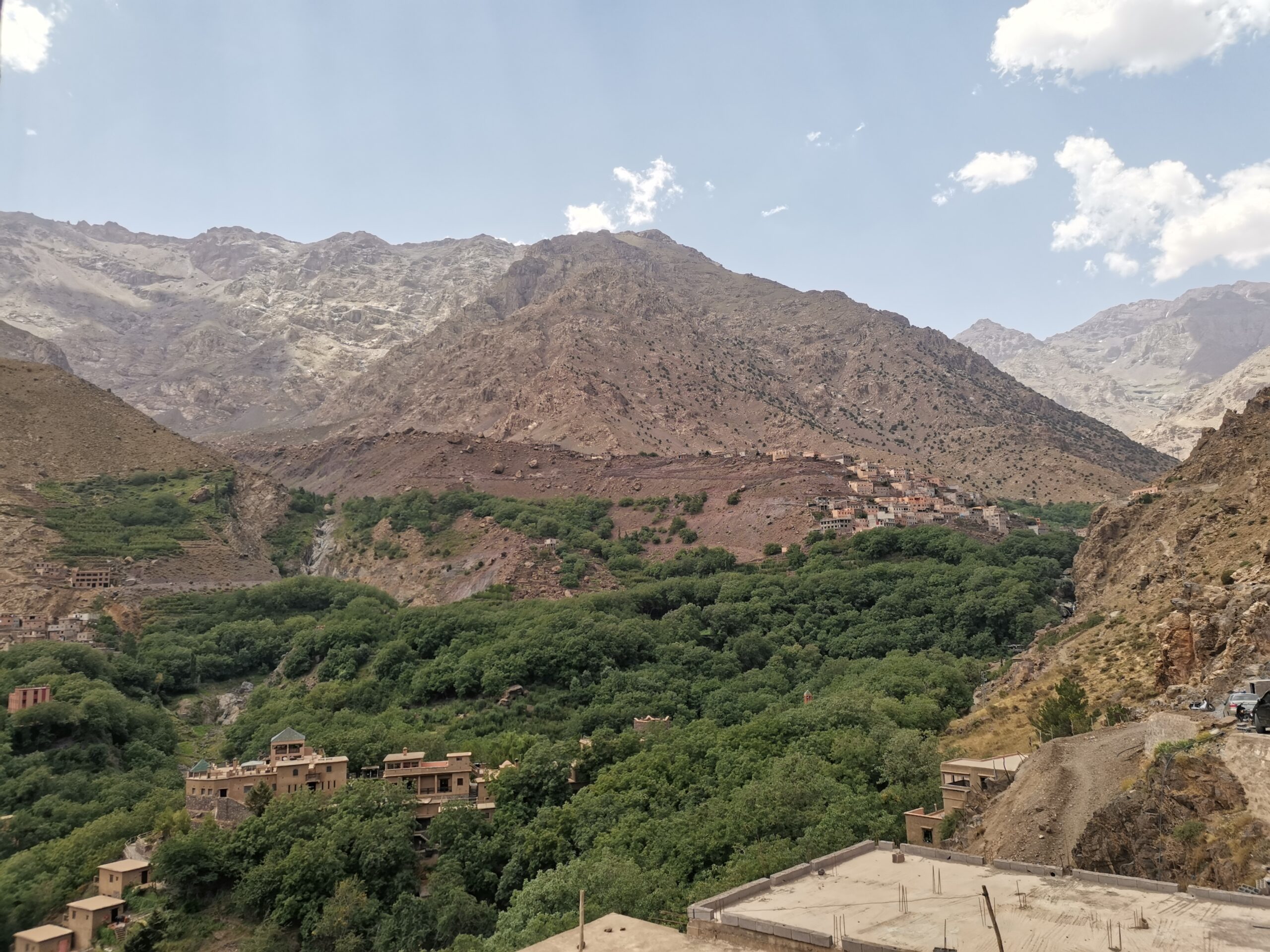
The landscape changes considerably with altitude and location. Deep valleys, terraced farmland, orchards, forests, rocky mountain slopes, and traditional Amazigh villages are found throughout the region, while the highest elevations can receive significant snowfall during winter. This variety makes the High Atlas suitable for everything from scenic drives and gentle valley walks to challenging multi-day treks. The High Atlas peaks and surrounding valleys offer some of Morocco’s most varied hiking trails, with mountain scenery changing significantly between the lower valleys and highest elevations.
The Western High Atlas is particularly accessible from Marrakech, with destinations such as Ourika Valley, Imlil, Ouirgane, and Toubkal National Park offering very different mountain experiences. Farther into the range, Aït Bouguemez provides a quieter setting for walking and exploring rural landscapes. Longer Morocco itineraries can also cross the High Atlas toward Ait Ben Haddou, Ouarzazate, the Dadès Valley, Todra Gorge, and eventually the Sahara Desert.
Whether you want to spend a single day away from Marrakech, stay several nights in a mountain village, or include trekking as part of a longer Morocco vacation, the High Atlas can be adapted to different travel styles and levels of activity.
Best Atlas Mountains Destinations Near Marrakech
Several of the most accessible High Atlas valleys can be reached from Marrakech, Several of the most accessible High Atlas valleys can be reached from Marrakech, making the Atlas Mountains in Morocco a practical addition even to shorter itineraries. Three valleys stand out for different reasons, and the right choice depends on what kind of experience a traveler is looking for.
Ourika Valley

The Ourika Valley is a popular day trip from Marrakech, featuring terraced farms and waterfalls along a narrow river valley in the atlas foothills. Day trips from Marrakech to the Ourika Valley are common for its natural beauty – the scenery shifts quickly from flat agricultural plains into a steep-sided valley with villages clinging to the slopes.
At Setti Fatma, short walks lead to cascading waterfalls above the village. Along the valley, visitors find local restaurants serving tagine beside the river, women’s cooperatives producing argan oil, and seasonal landscapes that change from almond trees in blossom during spring to dry golden hills in summer months. The Ourika Valley features terraced fields and waterfalls that are easily accessible on foot.
The valley can become busy on weekends and Moroccan holidays. Travelers with limited time who want a first introduction to the atlas mountains will find it rewarding, though an overnight stay provides a quieter experience.
Imlil and Toubkal National Park

Imlil is the main base for trekking Mount Toubkal and the primary gateway to Toubkal National Park. Sitting at roughly 1,740 meters, the village is surrounded by walnut and apple orchards, with views up toward the High Atlas ridgeline. Accommodation ranges from simple guesthouses and traditional mountain lodges to more comfortable boutique properties.
From Imlil, visitors can choose between:
- Short village walks through surrounding settlements
- Half-day hikes to nearby passes and viewpoints
- Full-day hikes into side lush green valleys
- Overnight trips to mountain refuges
- Multi-day trekking circuits
- The Mount Toubkal summit trek
Visitors do not need to climb Toubkal to enjoy Imlil. The area suits active travelers who want to spend time immersed in a mountain environment, walking between traditional Amazigh villages and along irrigation channels.
Ouirgane Valley
Ouirgane Valley is known for its warm climate and fruit trees, sitting at a lower elevation than Imlil with a noticeably greener, more relaxed atmosphere. Red-earth hillsides, olive groves, and scattered villages make it a quieter alternative to busier destinations.
Opportunities here include village walks, easy hiking, photography, and simply absorbing rural mountain landscapes at a slower pace. Ouirgane works particularly well for couples, families, senior travelers, and visitors who want mountain scenery without demanding ascents. Several comfortable guesthouses and small lodges have established themselves in the valley.
Mount Toubkal and Trekking in the High Atlas
Jebel Toubkal – also known as Mount Toubkal – stands at 4,167 meters, the highest summit in Morocco and across North Africa. Climbing Toubkal is a different undertaking from simply visiting the Atlas Mountains. Even in summer, when the route does not require technical climbing, the trek involves steep terrain, significant elevation gain, and physical effort at altitude.
The standard approach follows a two-day schedule: ascending from Imlil (1,740 m) to a mountain refuge at roughly 3,200 meters on day one, then reaching the summit and descending on day two. The Three Peaks Challenge includes Toubkal and Ouanoukrim summits for those seeking a more demanding objective.
Preparation matters. At higher elevations, hikers may feel the effects of altitude, so appropriate pacing, fitness, and acclimatization are important. Winter mountain conditions can be substantially more demanding and may require specialized equipment, suitable experience, and guidance according to current conditions.
Licensed local mountain guides are valuable for safety, navigation, and cultural insight on any serious trek. Trekking conditions vary considerably by season and elevation, so the most suitable time depends on the route, altitude, weather, and type of hike you are planning.
Travelers primarily interested in culture, scenery, and villages can enjoy excellent trekking without attempting the summit. Village-to-village walks, valley circuits, and overnight trips to mountain camps offer stunning views and opportunities to experience Amazigh culture and mountain landscapes without high-altitude challenges.
Aït Bouguemez: The Happy Valley
Aït Bouguemez sits in the Central High Atlas beneath the M’Goun Massif and is often known as the “Happy Valley.” This broad, high-altitude valley offers a quieter mountain experience than the more frequently visited areas around Marrakech. Terraced farmland stretches across the valley floors, fed by traditional irrigation channels, while small Amazigh villages of packed stone and earth cluster along the slopes.
The valley requires more travel time than destinations close to Marrakech and suits travelers with several days available. Walking here is village-to-village, with simple gîtes and homestays providing accommodation. The landscape appeals to hikers, photographers, slow travelers, and visitors drawn to rural life and Amazigh culture in a quieter part of Morocco’s mountains.
Dadès Valley and Todra Gorge: From the Atlas Toward the Sahara
Travelers crossing southern Morocco often experience spectacular mountain and canyon landscapes as they move from the High Atlas toward the Sahara. The Dadès Valley and Todra Gorge are highlights of this transition and feature prominently in longer road-trip and desert itineraries.
Dadès Valley

The Dadès Valley lies along the southern side of the High Atlas, with dramatic rock formations, deep valleys, and striking canyon landscapes. The landscape includes kasbahs, oasis settlements, winding mountain roads, and the famous rock formations commonly known as the “Monkey Fingers.”
Scenic drives through the switchbacks, photography stops, short walks into side canyons, and overnight stays in local guesthouses are typical experiences. The dadès valley commonly fits into routes between Marrakech, Ouarzazate, and the Sahara Desert.
Todra Gorge
Todra Gorge is a narrow limestone canyon near Tinghir where sheer walls rise dramatically above a river and palm oasis. Canyon walks, photography, hiking into the upper gorge, and rock climbing (where appropriately arranged with local guides) draw visitors. Nearby palm groves and villages along the river offer a gentler side to explore on foot.
Todra Gorge combines naturally with the Dadès Valley on itineraries continuing toward the Sahara dunes, making it a logical stop on multi-day loops starting or ending in Marrakech or Fes.
Middle Atlas Mountains: Cedar Forests, Lakes and Rural Landscapes
The Middle Atlas lies between Fes and the High Atlas, and its character is markedly different. Where the High Atlas is all vertical drama, the Middle Atlas presents rolling mountain terrain, volcanic plateaus, seasonal lakes, and meadows. Elevations are generally lower – peaks reach roughly 3,000–3,300 meters – and the landscape is greener and gentler.
The Middle Atlas features extensive cedar forests and opportunities to observe Barbary macaques in the wild. These forests are an important part of the region’s natural environment and contribute to the greener landscapes that distinguish the Middle Atlas from many areas of southern Morocco.
Ifrane
Ifrane’s distinctive alpine-style architecture and cooler climate make it an unexpected sight in Morocco. It serves as a gateway to the Middle Atlas and a base for exploring surrounding forests and lakes.
Azrou and the Cedar Forests
Near Azrou, ancient cedar woodland provides walking and nature observation opportunities. Barbary macaques live in these forests – visitors should observe them from a respectful distance and avoid feeding them.
The Middle Atlas appeals to travelers interested in nature, scenic drives, families, gentle walking, photography, rural culture, and road trips between Fes and southern Morocco.
Anti-Atlas Mountains: Southern Morocco’s Rugged Landscapes
The Anti-Atlas Mountains form a distinct region in southern Morocco and differ considerably in character from the High Atlas and Middle Atlas. The landscape features rugged mountains, dramatic rock formations, arid valleys, palm-filled oases, traditional villages, and areas of cultivated land.
The southern edge is drier and rockier than the north, with drought-tolerant vegetation – thyme, rosemary, argan, and scattered almond trees. Traditional agriculture persists in fertile valleys, and the landscape gradually transitions toward increasingly arid environments approaching the Sahara.
Tafraoute and the Ameln Valley
Tafraoute sits amid dramatic granite domes and the palm-filled Ameln Valley. Walking, photography, scenic drives, and village exploration are the main draws.
Jbel Sirwa and Surrounding Landscapes
Jbel Sirwa (3,304 m) rises between the High Atlas and Anti Atlas, a volcanic massif that appeals to more adventurous travelers seeking remote trekking away from established circuits. The region around it connects the two mountain systems and offers access to remote Amazigh villages and rural landscapes.
The anti atlas works well combined with southern Morocco itineraries, particularly during winter and spring when the High Atlas may still be snowbound at higher elevations.
High Atlas vs Middle Atlas vs Anti-Atlas: Which Should You Visit?
| Region | Best For | Typical Landscapes | Good Starting Point |
|---|---|---|---|
| High Atlas | Hiking, trekking, villages, dramatic mountains | High peaks, valleys, mountain villages | Marrakech |
| Middle Atlas | Nature, forests, families, road trips | Cedar forests, lakes, rolling mountains | Fes |
| Anti-Atlas | Photography, scenic drives, quieter travel | Arid mountains, valleys, rock formations | Agadir / southern Morocco |
For first-time visitors with limited time, the High Atlas is often the easiest choice because of its accessibility from Marrakech and the variety of experiences available, from scenic drives and gentle valley walks to multi-day trekking. The Middle Atlas is particularly rewarding for travelers interested in cedar forests, nature, relaxed road trips, and routes between Fes and southern Morocco, while the Anti-Atlas suits travelers looking for quieter landscapes, photography, scenic drives, and less-visited areas of southern Morocco.
On a longer Morocco itinerary, it is possible to experience more than one Atlas region, particularly when combining Marrakech, Fes, the mountains, the Atlantic coast, and the Sahara Desert.
Best Time to Visit the Atlas Mountains in Morocco
There is no single best month for every trip. Conditions vary considerably by altitude and region.
Spring – March to May
Spring is one of the most appealing seasons for exploring the Atlas Mountains, particularly for walking and hiking at lower and moderate elevations. Valleys become greener, seasonal flowers may appear, and snow can remain on the highest peaks. Conditions vary considerably with altitude, so high-mountain routes may still have winter conditions even when lower valleys are mild.
Summer – June to August
Summer can be hot in the lower valleys, particularly during the middle of the day, while higher elevations generally offer cooler conditions. This can be a suitable season for high-altitude hiking and trekking, although travelers should still prepare for strong sun, changing mountain weather, and significant temperature differences between daytime and night.
Autumn – September to November
Autumn is another excellent period for exploring the Atlas Mountains. Conditions are often comfortable for walking and sightseeing, and the season works particularly well for travelers combining the mountains with southern Morocco and the Sahara Desert. As the season progresses, temperatures become cooler, especially at higher elevations.
Winter – December to February
Winter brings colder conditions and snow to the higher Atlas Mountains. Some high-altitude routes become considerably more challenging, while lower valleys and parts of the Anti-Atlas can remain accessible. Travelers planning winter trekking should consider current weather, road and trail conditions and use appropriate equipment and local guidance where necessary.
For many travelers, spring and autumn offer particularly comfortable conditions, but the best time to visit the Atlas Mountains ultimately depends on the region, elevation, activities, and other destinations included in your Morocco trip.
How Many Days Do You Need in the Atlas Mountains?
1 Day
Suitable for travelers based in Marrakech wanting a first taste of the mountains – Ourika Valley, Imlil, or Ouirgane can each be visited on a day trip.
2–3 Days
Allows for overnight stays in the mountains, village walks, half-day hikes, and a more immersive experience around Imlil, Ouirgane, or another High Atlas area.
4–6 Days
Enough time for more substantial trekking, multiple valleys, or , and the southern end of the High Atlas.
One Week or More
Suits travelers interested in multi day treks, extensive photography, rural culture, or visiting multiple atlas regions. Itinerary design should account for travel time between destinations rather than simply counting stops.
Combining the Atlas Mountains With a Morocco Itinerary
The Atlas Mountains fit naturally into broader Morocco trips. Here are common combinations:
Marrakech + High Atlas
Ideal for shorter vacations. Spend a few days in Marrakech and add one to three nights in the mountains for a city-and-nature trip.
Marrakech + Atlas Mountains + Ait Ben Haddou + Ouarzazate
The classic route crosses the High Atlas from Marrakech toward Ouarzazate, passing through dramatic mountain passes and arriving at the famous kasbahs on the southern side.
Atlas Mountains + Sahara Desert
Many longer Morocco itineraries naturally cross the High Atlas before continuing through the Dadès Valley and Todra Gorge toward the Sahara dunes. This is one of Morocco’s most rewarding road journeys.
Fes + Middle Atlas + Sahara Desert
Routes south from Fes pass through Middle Atlas cedar forests before continuing toward the desert – a different landscape experience from the Marrakech-based routes.
Atlas Mountains + Atlantic Coast
Combining mountains with the atlantic coast – including destinations like Essaouira – gives travelers varied scenery and a change of pace between mountain and ocean.
How to Get to the Atlas Mountains
Access depends on which region you want to visit.
From Marrakech
Marrakech is the main gateway to the Western High Atlas. Roads from Marrakech provide access to Ourika, Imlil, Ouirgane, and other areas of the Western High Atlas. Longer routes cross the mountains toward Ouarzazate and south toward the Sahara.
From Fes
Fes provides access to Middle Atlas destinations including Ifrane, Azrou, and routes continuing south through the cedar forests.
From Agadir and Southern Morocco
Agadir and the Souss region provide access to Anti-Atlas areas including Tafraoute and the Ameln Valley.
Transportation options include private vehicle and driver, rental car, organized excursions, and shared local transportation. Private transportation provides the greatest flexibility for scenic stops, photography, and village visits along mountain roads.
Where to Stay in the Atlas Mountains
Accommodation styles vary considerably across the mountains:
- Traditional guesthouses – family-run properties in villages, often with home-cooked meals
- Mountain lodges and kasbah-style properties – more comfortable options in established destinations like Imlil and Ouirgane
- Eco-lodges – increasingly available in quieter valleys
- Mountain refuges – basic shelters on trekking routes, particularly near Toubkal
- Rural hotels – simple but functional accommodation in towns like Ouarzazate or Tinghir
Standards vary with location and remoteness. The atlas mountains are home to options ranging from very basic mountain accommodation to higher-comfort properties. Choosing the right balance depends on personal preferences and the specific valleys visited.
What to Pack for the Atlas Mountains
Packing depends on altitude, season, and planned activities. Essentials include:
- Comfortable walking shoes or hiking boots
- Layered clothing for large temperature swings between day and night
- Sun protection (sunscreen, hat, sunglasses)
- Reusable water bottle
- Lightweight rain protection
- Small daypack
- Warmer clothing for evenings at elevation – even in summer
- Trekking poles for travelers who find them helpful on steep terrain
Travelers attempting serious trekking or winter routes above 3,000 meters require more specialized equipment. Snow can linger at higher elevations well into spring.
Amazigh Culture in Morocco’s Atlas Mountains
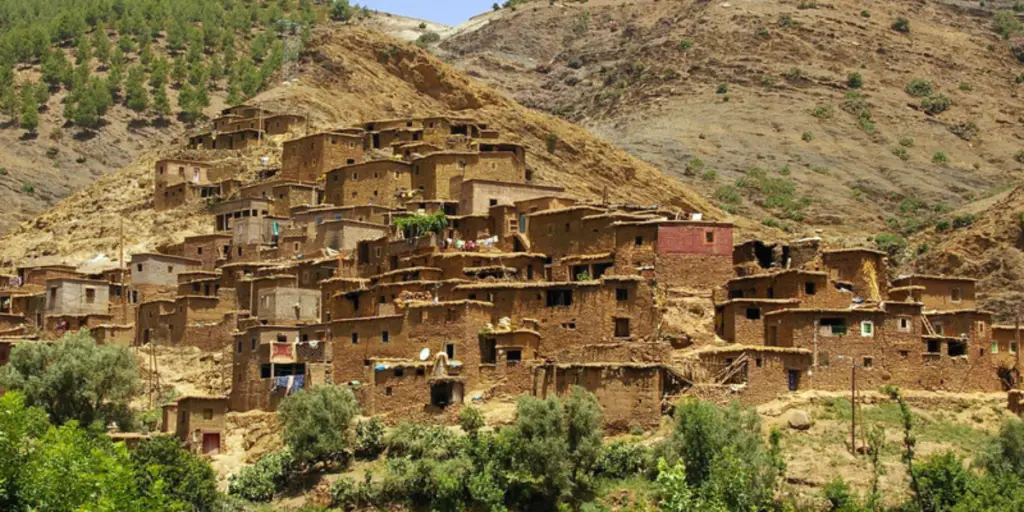
The Amazigh people, sometimes referred to as Berbers, have deep historical and cultural roots across Morocco and North Africa. Amazigh communities are an important part of life throughout the Atlas Mountains, with regional languages, traditions, architecture, agricultural practices, crafts, and customs that vary from one valley and mountain region to another.
In many mountain areas, traditional Amazigh villages are surrounded by terraced fields, orchards, grazing land, and irrigation systems adapted to the local environment. Agriculture and livestock remain important in many rural communities, while weekly markets connect villages with nearby towns and provide places to trade food, household goods, crafts, and other products.
Hospitality is an important part of Moroccan culture, and visitors may be welcomed with Moroccan mint tea during local encounters. Traditional crafts, including weaving and other handmade products, can also be found in mountain communities. Travelers interested in local culture should approach these experiences with curiosity and respect, remembering that villages are people’s homes and workplaces rather than tourist attractions.
Amazigh communities in the Atlas Mountains combine longstanding cultural traditions with contemporary Moroccan life. Respectful travel means recognizing these communities as living, evolving places rather than treating them as exhibits from the past.
Responsible Travel in the Atlas Mountains
Practical recommendations for respectful travel in the mountains:
- Use knowledgeable local guides when trekking or visiting remote areas
- Support locally owned accommodation and services
- Ask permission before photographing people
- Avoid feeding wildlife, including Barbary macaques
- Minimize plastic waste and carry out what you carry in
- Stay on established trails to protect farmland and fragile slopes
- Respect livestock, crops, and private property
- Dress appropriately in rural communities
- Buy locally made products where you can
- Follow local guidance on weather and trail conditions
Drone regulations can change – check current rules before flying. Responsible travel in the atlas helps ensure that mountain communities benefit from tourism.
Are the Atlas Mountains Suitable for Families?
Many Atlas experiences work well for families, though the right location and activities depend on children’s ages, interests, season, and fitness levels.
Family-friendly possibilities include short village walks, scenic drives through mountain passes, gentle valley walks, nature observation, rural accommodation with home-cooked meals, and short excursions from Marrakech. Ouirgane and the Ourika Valley are examples of areas that suit relaxed family travel, as are selected Middle Atlas destinations with their lower altitudes and gentler terrain.
Demanding high-altitude trekking is a separate category and should be evaluated based on the specific children involved. Most people traveling with younger children will find plenty to explore in the accessible valleys without venturing above the treeline.
Frequently Asked Questions About the Morocco Atlas Mountains
Where are the Atlas Mountains in Morocco?
The Atlas Mountains run through central and southern Morocco as part of a broader mountain system stretching across North Africa. Morocco’s three main ranges are the High Atlas in central Morocco, the Middle Atlas in north-central Morocco, and the Anti-Atlas in southern Morocco.
Which Atlas Mountains are closest to Marrakech?
The Western High Atlas, including Ourika, Imlil, and Ouirgane, is the closest mountain region to Marrakech.
How far are the Atlas Mountains from Marrakech?
Several High Atlas valleys are accessible from Marrakech by road, although distances and travel times vary depending on the specific destination.. Distances and travel times vary depending on the specific destination.
Can you visit the Atlas Mountains on a day trip from Marrakech?
Yes. Ourika Valley and Imlil are both feasible as day trips. However, an overnight stay allows a quieter, more immersive experience.
How many days should I spend in the Atlas Mountains?
One day provides a first introduction. Two to three days allow walking and village visits. Longer stays suit trekking and exploring multiple valleys.
Do I need a guide in the Atlas Mountains?
For serious trekking, unfamiliar routes, and the Toubkal summit, traveling with an appropriately qualified local guide can be valuable for navigation, safety, and local knowledge. For short walks in well-visited valleys, a guide is less essential but still adds cultural context.
Is Mount Toubkal difficult to climb?
The Mount Toubkal summit involves steep, rocky terrain, significant elevation gain, and hiking at high altitude. Fit and experienced hikers may find the ascent manageable in suitable conditions, but it should not be underestimated. Winter ascents can be considerably more demanding and may require specialized equipment and experience.
What is the best time to visit the Atlas Mountains?
Spring and autumn often provide comfortable conditions for walking and sightseeing, while summer can suit higher-altitude trekking. Winter brings colder temperatures and snow at higher elevations. The best time ultimately depends on the region, altitude, and activities you are planning.
Does it snow in Morocco’s Atlas Mountains?
Yes. Snow falls at higher elevations during winter. Yes. Snow falls at higher elevations in Morocco’s Atlas Mountains during winter and can remain on the highest peaks into spring. Conditions vary considerably according to altitude, location, and the particular year.
Can I combine the Atlas Mountains with the Sahara Desert?
Yes. Many Morocco routes cross the High Atlas before continuing south through valleys and gorges toward the Sahara. This is one of the country’s classic itinerary shapes.
Are the Atlas Mountains suitable for families?
Many valleys and gentle activities are family-friendly. Demanding summit treks require separate consideration based on children’s ages and fitness.
What should I wear in the Atlas Mountains?
Layered clothing, comfortable walking footwear, and sun protection are essential. In rural communities, modest dress is respectful. Evenings at elevation can be cool even in summer.
Planning a Private Atlas Mountains Trip With Chegaga Travel
Choosing between the High Atlas, Middle Atlas, and Anti-Atlas – and deciding how to combine them with the rest of Morocco – depends on travel dates, available days, fitness levels, interests, accommodation preferences, and the other destinations in your trip.
Chegaga Travel can incorporate Atlas Mountains experiences into a private, tailor-made Morocco itinerary with private air-conditioned transportation, personalized route planning, local guides where appropriate, and selected accommodations matched to your preferences.
Example itinerary concepts:
- Marrakech & High Atlas Escape – city exploration and mountain walking
- High Atlas, Ait Ben Haddou & Sahara Journey – mountains, kasbahs, and desert
- Family-Friendly Marrakech & Atlas Vacation – gentle valleys and cultural experiences
- Fes, Middle Atlas & Sahara Route – cedar forests, landscapes, and desert camps
- Atlas Mountains & Atlantic Coast Vacation – mountains and ocean
Ready to include the Atlas Mountains in your Morocco vacation? Tell us your travel dates, interests, preferred destinations, accommodation style, and ideal pace, and Chegaga Travel can create a private, tailor-made Morocco itinerary designed around you.